

Today, borders are bridges for interaction and cooperation
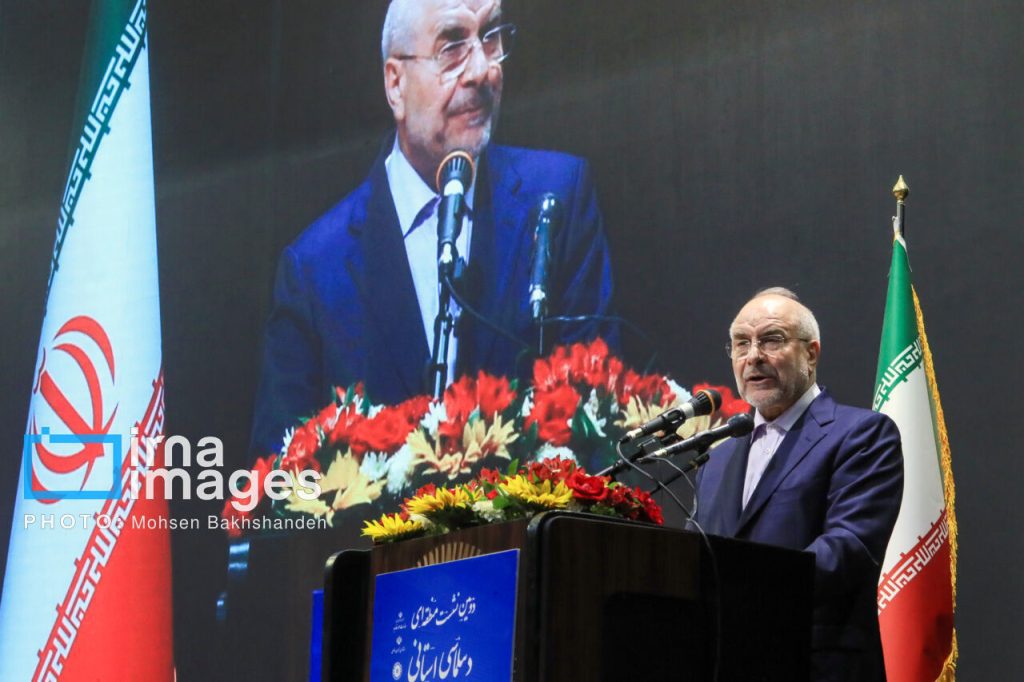
Speaker of the Islamic Republic of Iran’s Legislature stated: Today, borders are no longer restrictive lines but rather bridges of interaction and cooperation. Therefore, to realize this meaning, a shift must occur in our mindset and policies. Borders should be starting points, not endpoints.
MohammadBagher Ghalibaf, Speaker of the Parliament of the Islamic Republic of Iran, stated at the regional conference on provincial diplomacy in Mashhad: Through cooperation between the Ministry of Foreign Affairs, provincial governors, and the private sector, the country’s diplomacy can be shifted from centralization to interaction, and from formalities to dynamism.
He stated that the legislative parliament in the Islamic Republic of Iran can provide the basis for amending border trade laws, facilitating exports, and supporting knowledge-based companies, which has also been put on the agenda.
At the regional diplomacy meeting in Shiraz, it became clear that provincial governors and the private sector can transform diplomacy from formalities to dynamism; now, Mashhad is beginning a new phase and transitioning from dialogue and ideas to mechanisms.
Provincial diplomacy is one of the external faces of productive governance and the field manifestation of national para-diplomacy, meaning the targeted and coordinated involvement of provinces in the realm of foreign interactions within the framework of national policy. In this model, the macro design is done at the center, but it is the provincial governors and economic actors who, with field knowledge and close connection to border realities, place the pieces of the national interest puzzle in their correct places. However, it is necessary to be vigilant so that provincial diplomacy, alongside great opportunities, turns border challenges into opportunities.
A country with Iran’s geopolitical position cannot limit its foreign policy to official relations. Therefore, foreign policy must operate on two levels: at the national level for direction and macro interests, and at the transnational and provincial level for field implementation and utilizing provincial capacities. Coordination between these two levels transforms foreign policy from a reactive state to an initiative-driven one and requires intelligent national and transnational work so that each province, according to its comparative advantage, plays a clear and specific role in the country’s diplomacy.
Global experience has shown that countries like China, Turkey, India, and some Central Asian countries have been able to multiply their national power by activating cities and states in economic diplomacy. Iran, with its historical background and unique capacities, also has the necessary potential to operate at both national and transnational levels and can, in alignment with China and Russia as strategic partners, become the axis of regional and global multilateral cooperation.
Such cooperation, in addition to strengthening economic and technological links, finds meaning in confronting global unilateralism and hegemonic structures. A clear example of this transformation is the game of tariffs and the discriminatory trade policies of the United States, which are pursued with the aim of imposing its will on the global economy, but nations no longer submit to this monopoly.
The failure of the United States and three European countries in illegally activating the snapback mechanism and the formal opposition of two permanent members of the Security Council is a sign of the new world—a world whose decisions are not written in one capital.
Alongside foreign policy at the national and global levels, a significant part of Iran’s regional power lies in its provinces: in the borders, border markets, free ports, and in the pilgrims, tourists, and entrepreneurs who interact with the world daily in the provinces. In this view, spatial planning is not just a development program but a dimension of national diplomacy. Therefore, foreign policy should be designed based on a map of provincial capacities so that each region, according to its geographical and cultural advantage, advances a part of Iran’s regional strategy.
Introducing the capacity of each province should be done by the people of that province themselves, from entrepreneurs and merchants to academics and cultural elites. With their field knowledge, they can introduce the real face and local capacity of their province to embassies, target markets, and regional public opinion, making the path of cooperation simpler and more sustainable. In this framework, each province has a specialized role and a prominent advantage that, alongside other provinces, can shape a national division of labor in foreign policy.
Provincial diplomacy means moving beyond centralization and achieving synergy. Each province is part of the national strategy, and by actively participating in the network of provincial cooperation, it can be an open window from Iran to the world—a window that shows the world the culture, trust, cooperation, and true face of the nation. Given Iran’s extensive borders, each border province is, in fact, a living embassy and a point of contact for the Iranian people with its neighbors.
Today, borders are no longer limiting lines but bridges of interaction and cooperation. Therefore, to realize this meaning, a change must occur in our minds and policies. The border should be a starting point, not a stop. Border provinces should be gateways to regional markets, not the last station of bureaucracy. In this view, borders can become smooth, low-cost passageways for trade, tourism, and cultural exchanges—a current that grows security from within development and cooperation.
A purely security-oriented view of borders must give way to a development-oriented and cooperation-generating view because sustainable security springs from development in the border areas. On the path to realizing effective provincial diplomacy, economic, cultural, and civilizational ties play a fundamental role. Sustainable relations are formed in the context of trust and cultural commonality, and all the historical and linguistic ties of Iran with surrounding nations present an image of an Iran reliant on ethics, trust, and mutual cooperation.
Economic and regional diplomacy should not remain limited to economy and culture. Our experience shows that sustainable ties are formed when cooperation is multidimensional. Based on this, synergistic action can be taken in five strategic areas of cooperation: diplomatic and political, economic, social and cultural, security and defense, and environmental.
Now, a common understanding of threats such as terrorism, extremism, judicial insecurity, and climate change has been formed between Iran and its neighbors and strategic partners. Our region is not an arena for competition and fueling potential challenges, but a field for utilizing existing opportunities, and the groundwork for synergy and shared progress will be formed through this path.
The three provinces of North Khorasan, Razavi, and South Khorasan are one of Iran’s strategic spheres—the link connecting the east and center of the country and Iran’s desert passageway to Central Asia and the subcontinent. We know these three provinces as Greater Khorasan, which, due to their adjacency to Afghanistan and Turkmenistan and proximity to Central Asia, are the axis of Iran’s eastern exchanges and have the capacity to become the model of provincial and border cooperation in the east of the country.
In this sphere, Mashhad holds a distinguished and multifaceted position: a city that is the center of pilgrimage and spirituality for Iranians and also a scientific and academic pole of the eastern country; a city that annually hosts 25 to 30 million domestic pilgrims and three million foreign pilgrims. This volume of human resources is a unique cultural and economic capital, and Mashhad can become the focal point of pilgrimage, knowledge, and regional economic cooperation—provided this capacity is managed with a diplomatic perspective and economic planning. The pilgrimage and cultural economy will become active not only in Mashhad city itself but in a network of Iran’s civilizational destinations.
Iranian pilgrims and travelers to Mashhad can, after visiting the shrine of Imam Reza (A.S.), travel via designed and synergistic routes to other historical and tourist provinces of the country such as Fars, Isfahan, and Azerbaijan. This connection can create a chain of economic and cultural tourism that turns Iran into the center of pilgrimage and tourism in the region.
If the scientific, economic, and cultural capacities of Mashhad are properly managed within the framework of public and provincial diplomacy, Mashhad will become the sole model of regional cooperation in eastern Iran and can become the symbol of faith, rationality, and progress in Iran’s foreign policy.
Source: IRNA News Agency. News Code: 85975119